

Feature
Gamification
A daily habit that's not studying, but still pays off.
Last updated: August 17, 2026

Non-academic but useful: a daily habit layer that brings students back to the platform every day. The student menu carries 13 cognitive mini-games: Speed Round, Four Operations, Logic, Sudoku, Stroop Test, Attention Test (N-Back), Sequence Memory, Math Tower, Focus Flow, Go / No-Go, Card Sort, Tower of Hanoi and Tangram. They were designed together with school Guidance and Psychological Counseling (PDR) specialists, so a student's attention, inhibition, working memory, and logic/problem-solving can be gauged through play. Every session is logged individually, and the student's single gamification profile updates its XP, level, and current streak from those logs. A leaderboard is kept per game and ranks only within the student's own institution.
Live preview
A small, standalone version of the app's 'Games' section. All 13 games in the product are listed; 3 of them are genuinely playable here. Scoring, XP and level logic match the real product.
Games · 13 games
Level 1Speed Round
Speed
Logic
Logic
Sudoku
Puzzle
Attention Test (N-Back)
Working memory
Math Tower
Maths
Focus Flow
Focus
Go / No-Go
Inhibition
Card Sort
Cognitive flexibility
Tower of Hanoi
Planning
Tangram
Spatial
The card count matches the product: the student menu carries 13 games. 3 of them are playable in this demo; the rest show the remaining inventory.
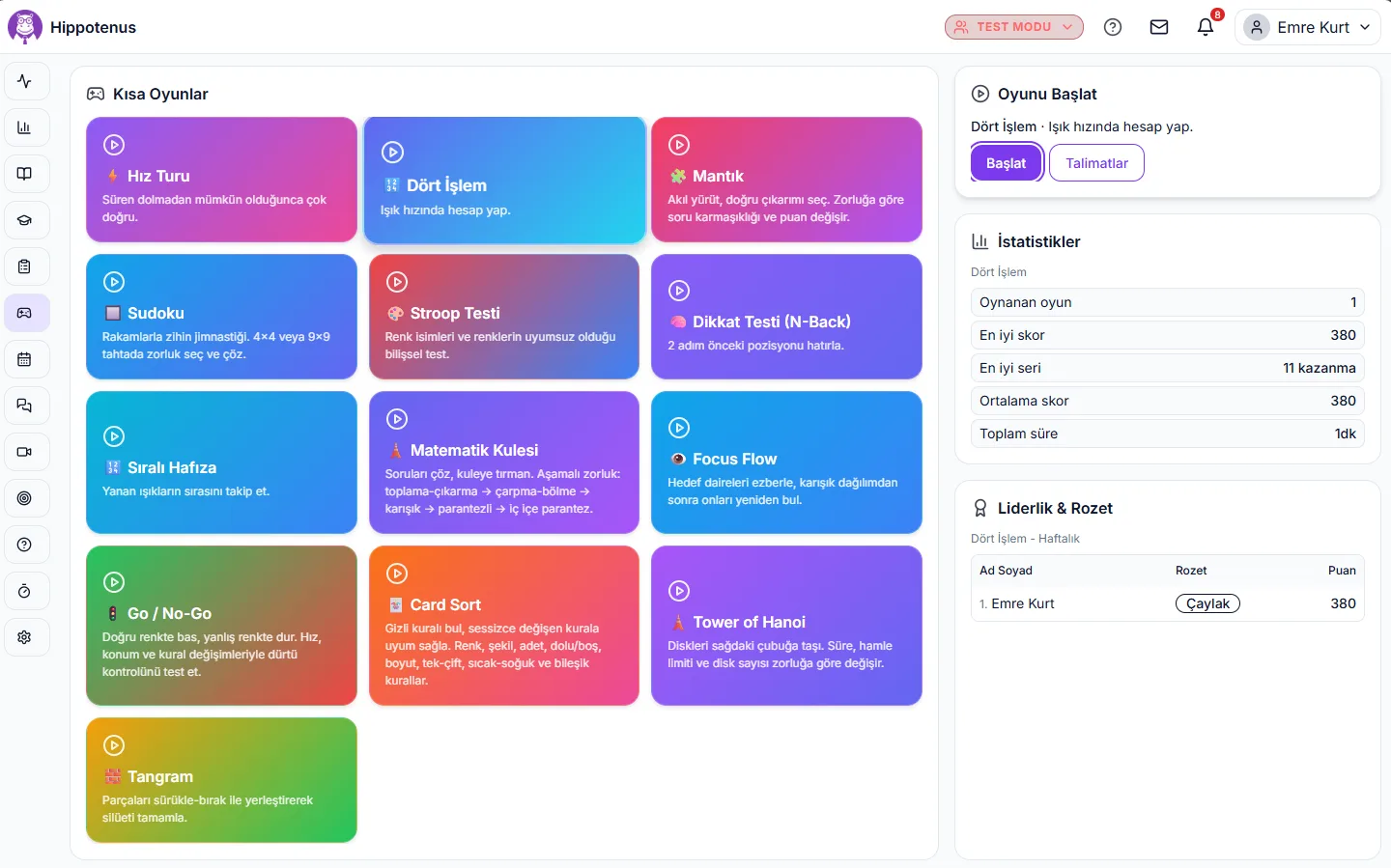
In the real product: all 13 cognitive games, a separate log for every session, an XP/level/streak profile and an in-school leaderboard for each game.
How it works
Pick a game and play
The student chooses from 13 mini-games. Most carry easy/medium/hard tiers; Math Tower and Focus Flow instead adapt themselves to the student's pace.
Detailed performance logging
Every game session is logged individually: which game was played, the score, number of questions answered and answered correctly, duration, the streak at that moment, and the accuracy percentage.
XP, level and streak update
The student's single gamification profile automatically updates its XP, level, and current streak from these logs; the XP earned and the level bar appear on the result screen the moment a round ends.
In-school leaderboard
A leaderboard is kept per game, ranks only within the student's own institution, and awards a Novice, Master, or Legendary rank based on score.
What it offers each role
Student
Plays 13 mini-games, earns XP and streaks from every session, levels up, and takes a place on their institution's leaderboard.
- 13 cognitive mini-games in the student menu: Speed Round, Four Operations, Logic, Sudoku, Stroop Test, Attention Test (N-Back), Sequence Memory, Math Tower, Focus Flow, Go / No-Go, Card Sort, Tower of Hanoi and Tangram.
- The games were designed together with school Guidance and Psychological Counseling (PDR) specialists to gauge a student's different cognitive skills, like attention, inhibition, working memory, and logic/problem-solving.
- Stroop Test, Go / No-Go, and Card Sort are gamified adaptations of clinical attention-inhibition and cognitive-flexibility tasks.
- Every game session is logged individually, including game type, score, questions answered/correct, duration, streak at the time, and accuracy percentage.
- A single gamification profile tracks XP, level, and current streak in one place, and the XP earned shows up at the end of every round.
- A leaderboard is kept per game, awarding Novice, Master, and Legendary ranks by score.
- Leaderboards are scoped per institution; students compete within their own school, not on a single mixed global leaderboard.
- Math Tower and Focus Flow adjust their difficulty on their own, following the student's correct/incorrect pace.
- The games module is designed as student-only in the navigation; teachers and admins don't use it as a tool for their own work.
Frequently asked questions
The student menu carries 13 cognitive mini-games: Speed Round, Four Operations, Logic, Sudoku, Stroop Test, Attention Test (N-Back), Sequence Memory, Math Tower, Focus Flow, Go / No-Go, Card Sort, Tower of Hanoi and Tangram. Each one trains attention, inhibition, working memory, logic/problem-solving, or focus.
Yes. The cognitive mini-games in the gamification module were designed together with school Guidance and Psychological Counseling (PDR) specialists, so they can gauge a student's different cognitive skills, like attention, working memory, and logic/problem-solving, through play.
Every round earns XP based on its score; as XP accumulates you level up, and the XP earned along with the level bar appears on the result screen the moment the round ends. Playing on consecutive days also raises your streak.
Generic. All 13 are standalone brain-training exercises targeting cognitive skills like attention, inhibition, working memory, logic, and focus. Four Operations and Math Tower train numerical fluency, but none of them pull questions from the institution's question bank.
The games module is student-only; there is no separate games screen in the teacher panel. Students see their own statistics and their institution's leaderboard from the games page.
No. Leaderboards are scoped per institution; students are only ranked against other students at their own school, there's no single global leaderboard mixing every institution together.
Yes. Every game session is logged individually: which game was played, the score, questions answered and answered correctly, duration, the streak at that time, and the accuracy percentage are all recorded.
Related features