

Feature
Overall Success Score
One score, five dimensions, recalculated every night.
Last updated: August 17, 2026
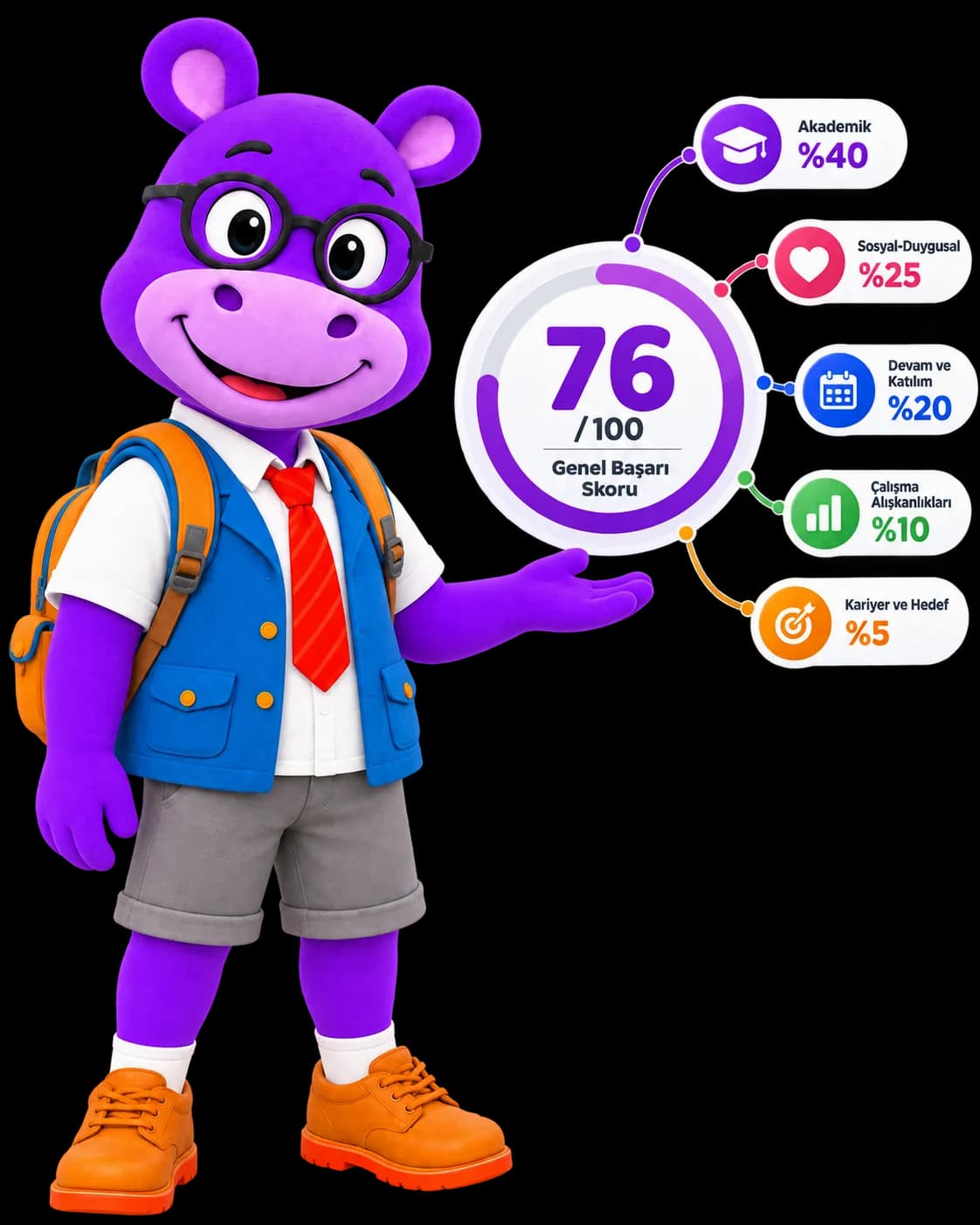
It weighs academic (40%), social-emotional (25%), attendance (20%), habits (10%) and goals/career (5%) dimensions to evaluate each student with a single score from 0 to 100. When a sub-metric drops below its threshold, the teacher or coach receives an automatic notification, so a decline is caught as it happens rather than at the end of an exam. The score is recalculated every night at 02:30 and can be tracked as a trend over time. If a student is missing data for a particular sub-metric, that weight isn't simply dropped, it's redistributed proportionally among the remaining metrics, so missing data never unfairly lowers the score.
Live preview
Open a dimension, drag its sub-metrics and watch the score change with the real weights (40/25/20/10/5%). Remove the data from one metric to see its weight redistribute across the rest, what happens below the risk threshold, and how the same score looks to four different roles.
Overall success score
Recalculated every night
Academic, Career & Goals is below the risk threshold — the teacher and coach are notified automatically.
When a sub-metric has no data the system never invents a number: that metric's weight is ignored and the remaining metrics in the same dimension are re-normalised. Plan Completion sits like that below — try removing and restoring the sliders.
5 dimensions, 14 sub-metrics
One score, four viewpoints
My own dimension breakdown
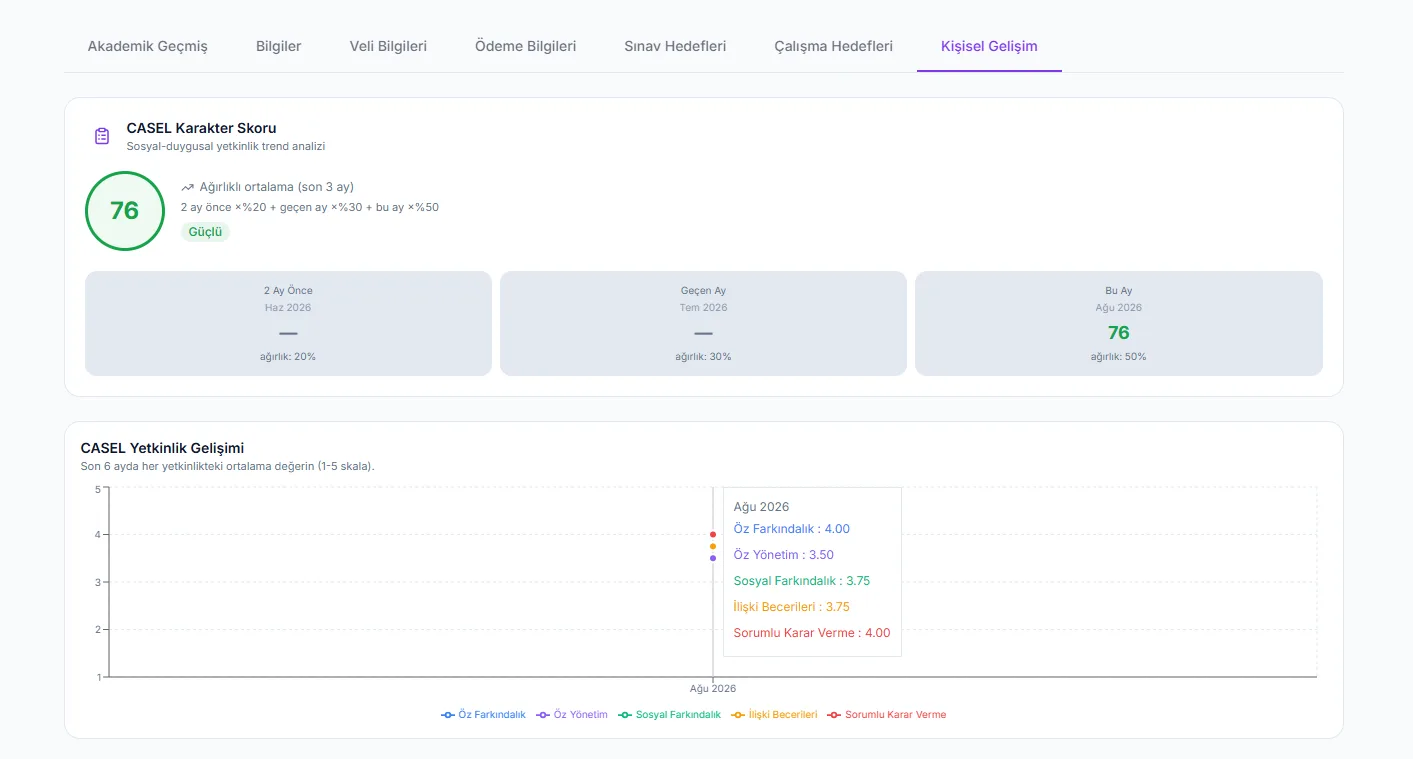
In the real product: 5 dimensions and 14 sub-metrics are recalculated nightly at 02:30, missing metrics are re-normalised, and students below the risk threshold trigger automatic notifications.
How it works
14 sub-metrics, 5 dimensions
14 sub-metrics grouped under academic, social-emotional, attendance, habits and goals/career feed a single 0-100 score using fixed weights of 40/25/20/10/5 percent.
Nightly 02:30 computation
Every student's score is recalculated in a nightly batch at 02:30 (Istanbul time). If the score shown on screen is more than 24 hours old, it's recalculated on the spot the moment the page loads.
Fair redistribution for missing data
If a student is missing data for a sub-metric, that weight isn't dropped, it's redistributed proportionally among the metrics that do have data; for example, a student with no live-class records has that share shifted into their login/engagement and study-plan metrics.
CASEL competency measurement
A monthly social-emotional development survey scores the five CASEL competencies on a 1-5 scale, and the average is multiplied by 20 to land on 0-100. The character score is a weighted average of the last three months (20% + 30% + 50%), with the weights re-normalised when a month has no data. A separate chart tracks how each competency moved over the last six months.
Threshold-based early alerts
When any of 9 threshold rules is triggered, the teacher or coach gets an automatic notification; the same student-rule combination won't fire again for 7 days, preventing alert fatigue.
Role-scoped visibility
A super admin sees every student, an institutional admin sees their whole institution, a private tutor sees only their own students, and a homeroom/subject teacher sees the classes and branches they're responsible for.
Habit data comes from Pomodoro
All three sub-metrics of the Study Habits dimension are fed by the student's Pomodoro sessions: focus quality (50%) is the session-weighted average of the last 14 days, study volume (30%) is actual study time against the weekly goal, and routine consistency (20%) is how stable the study hour stays day to day. With no sessions the sub-metric stays empty and its weight is redistributed.
Daily check-in
Once a day the student is asked how they feel; the 7-day average of that emoji answer becomes the Emotional Regulation sub-metric and makes up 35% of the Social-Emotional dimension. For a new student whose CASEL survey is not filled in yet, the dimension is temporarily computed from this signal alone.
What it offers each role
Student
Fills in an emoji-based mood check-in, manually logs outside-platform study time (up to a 12-hour daily cap), and sees their own score, its five dimensions and its trend.
Teacher/Coach
Receives automatic risk alerts when a metric drops below its threshold and can intervene before the decline shows up in exam results; sees students they teach, their homeroom class, and their branch.
Parent
Tracks their child's overall score, its five dimensions and its trend over time, and is kept informed of risk alerts.
Admin
An institutional admin sees scores across their whole institution, while a super admin sees them across every institution, making it easy to spot broader trends.
- Five dimensions, academic (40%), social-emotional (25%), attendance (20%), habits (10%) and goals/career (5%), combine with fixed weights into a single 0-100 score.
- The score is built from 14 underlying sub-metrics, so one number reflects a broad data set.
- The score is recalculated for every student every night at 02:30 (Istanbul time).
- If the score shown on screen is more than 24 hours old, it's recomputed on demand the moment the page loads, so the data never goes stale.
- When a sub-metric is missing data, its weight isn't dropped, it's redistributed proportionally among the metrics that do have data.
- 65% of the social-emotional dimension comes from the CASEL Competency metric: self-awareness, self-management, social awareness, relationship skills and responsible decision-making, each measured on a 1-5 scale by a monthly survey.
- CASEL is an internationally recognised framework for school-based social-emotional learning; the guidance team tracks six months of growth across those five competencies on a dedicated chart.
- The remaining 35% is the Mood Regulation metric, a 7-day rolling average of emoji-based mood check-ins scaled to 0-100.
- The CASEL character score is not a snapshot of one survey but a weighted average of the last three months, so a single bad month never defines a student.
- Study time outside the platform, like with physical books, can be logged manually, capped at 12 hours a day to keep self-reported data realistic.
- 9 distinct threshold rules automatically catch risky drops in the underlying metrics.
- The same student-rule alert won't repeat for 7 days, so teachers and coaches don't face alert fatigue.
- Visibility is scoped by role: a super admin sees everyone, an institutional admin sees their institution, a private tutor sees only their own students, and a class/subject teacher sees the classes and branches they're responsible for.
- The Study Habits dimension is fed by the Pomodoro timer: focus quality, study volume and routine consistency are all computed from session data.
- A Pomodoro session can be tagged with a subject, so study time is also tracked per subject.
- The daily check-in is separate from the CASEL survey: the survey is a periodic competency measurement, the check-in a 7-day rolling average.
Frequently asked questions
The score is a weighted average of five dimensions: academic (40%), social-emotional (25%), attendance (20%), habits (10%) and goals/career (5%). These dimensions draw on 14 underlying sub-metrics and combine into a single number from 0 to 100.
The score is recalculated for every student in a nightly batch at 02:30 (Istanbul time). If the score shown on screen is more than 24 hours old, it's recomputed on the spot as soon as the page loads, so it never goes stale.
No. If a student is missing data for a sub-metric, that weight isn't dropped, it's redistributed proportionally among the metrics that do have data. For example, a student with no live-class records has that share shifted into their login/engagement and study-plan metrics instead.
CASEL (Collaborative for Academic, Social, and Emotional Learning) is an internationally recognised framework for school-based social-emotional learning, defining five competencies: self-awareness, self-management, social awareness, relationship skills and responsible decision-making. A monthly survey scores them on a 1-5 scale and the average is multiplied by 20 to land on 0-100. The character score is a weighted average of the last three months (20% two months ago, 30% last month, 50% this month); if a month has no data its weight is redistributed rather than lost. The metric makes up 65% of the social-emotional dimension.
Visibility is scoped by role: a super admin sees every student, an institutional admin sees students within their institution, and a private tutor sees only their own students. A regular teacher sees the students they directly teach, their homeroom class, any class/subject they're formally assigned to, and their branch.
When any of 9 threshold rules is triggered (for example, a metric dropping below its expected range), the teacher or coach receives an automatic notification. To avoid alert fatigue, the same student-rule combination won't fire again for 7 days.
A 7-day rolling average of the student's emoji-based mood check-ins feeds into the social-emotional dimension. Study time done outside the platform, like with physical books, is logged manually and capped at 12 hours a day to keep self-reported data realistic.
From the student's Pomodoro sessions. There are three sub-metrics: focus quality (50%) — a 0-100 quality score derived from interruptions, pauses and tab switches within a session, averaged across the last 14 days weighted by session; study volume (30%) — total actual study time against the weekly goal (manual study logs count too, with a 12-hour daily cap); and routine consistency (20%) — how stable the start hour has been over the last 14 days. With no sessions the dimension stays empty and its weight is redistributed.
No — they are two separate sub-metrics of the Social-Emotional dimension. CASEL (65%) is a periodic survey covering five competency areas. The daily check-in (35%) is a single emoji question asked every day, averaged over the last 7 days. For a new student whose CASEL is not filled in yet, the dimension is temporarily computed from the daily check-in alone and the interface marks it as still collecting data.
Related features